

RMD Rules for Gold IRAs and Traditional IRAs
Required minimum distributions start at age 73, whether you need the money or not. Missing the deadline costs you a 25% penalty on the amount you should have withdrawn (Source: IRS Publication 590-B). For Gold IRA holders, selling physical metals adds days of processing that paper-asset IRAs avoid. This article covers the calculation, the deadlines, the Roth advantage, and how you can plan ahead.
Since 2024, we have mapped more than 35 RMD scenarios across age brackets and account types to build the framework on this page.
Key Takeaways
- You must start yearly withdrawals from a Traditional IRA at age 73, rising to 75 if born in 1960 or later.
- Gold IRA holders must sell metals or take physical delivery to meet yearly withdrawals, which adds time and cost.
- Missing a required withdrawal costs you a 25% penalty, reduced to 10% if you fix it within two years.
What are Required Minimum Distributions?
A required minimum distribution is the smallest amount you must withdraw from a tax-deferred retirement account each year once you reach a certain age. The IRS created RMDs to ensure that money in Traditional IRAs, SEP IRAs, and SIMPLE IRAs eventually gets taxed. Without this rule, investors could theoretically defer taxes indefinitely by never withdrawing funds (see the IRS RMD rules page).
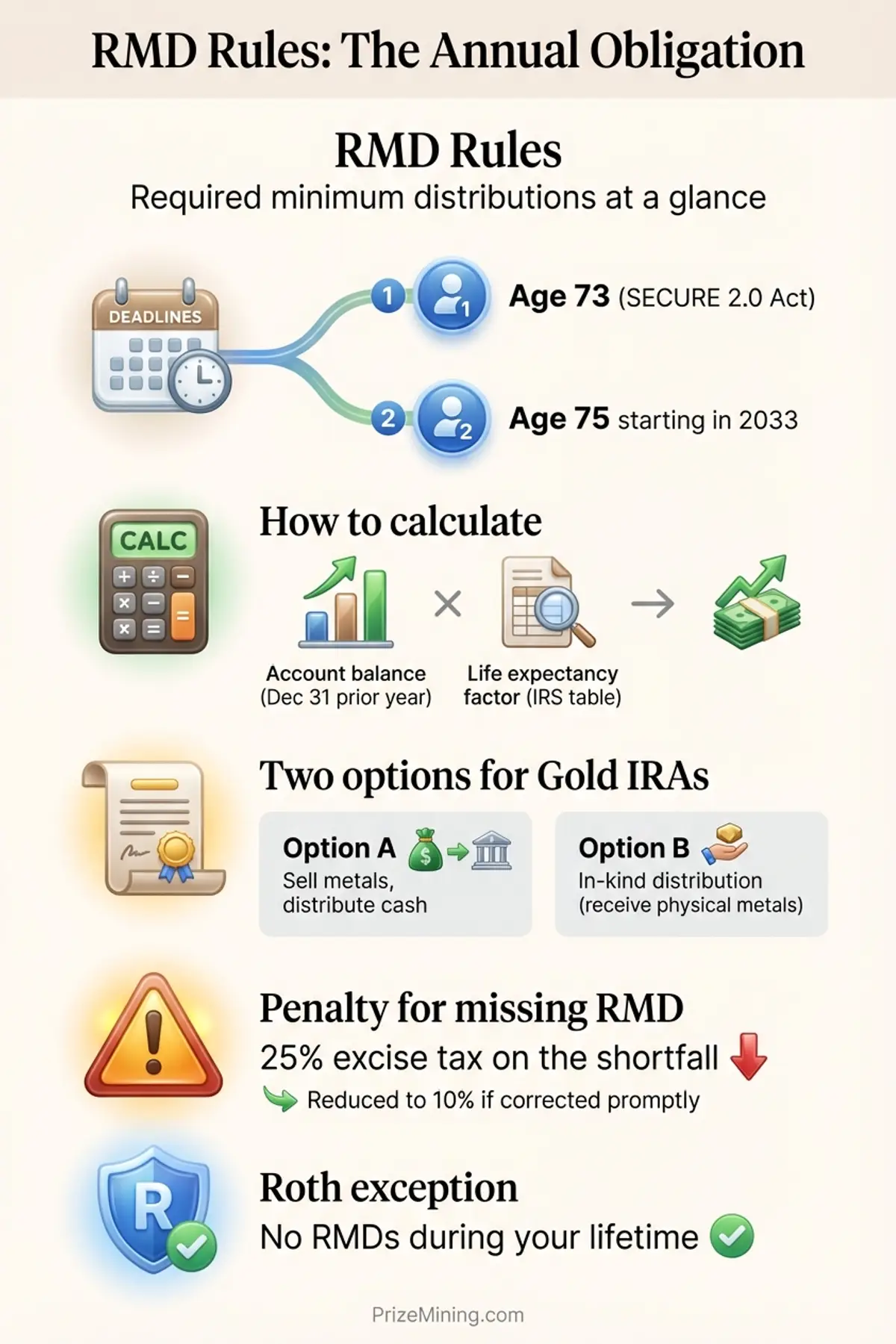
A Required Minimum Distribution is the annual amount the IRS forces you to withdraw from a tax-deferred IRA once you reach age 73 (under SECURE 2.0). Once RMDs begin, you owe a distribution every year regardless of market conditions, gold prices, or your cash needs. The RMD amount equals your December 31 prior-year balance divided by a distribution-period factor from the IRS Uniform Lifetime Table (Table III). Missing the deadline triggers a 25% excise tax, reducible to 10% if corrected within the IRS correction window.
RMDs apply to Traditional IRAs, SEP IRAs, SIMPLE IRAs, 401(k)s, 403(b)s, and most other employer-sponsored plans. They do not apply to Roth IRAs during the original owner's lifetime, a distinction we cover in detail below. For a broader view of how tax-deferred retirement accounts work with precious metals, our Gold IRA tax rules overview covers contribution limits, deductions, and distribution taxation.
When do RMDs start under SECURE 2.0?
The SECURE 2.0 Act, signed into law in December 2022, changed the RMD starting age for you and most other savers. If you turned 72 after December 31, 2022, your RMDs now begin at age 73. If you were born in 1960 or later, your starting age rises again to 75 beginning in 2033.
Your first RMD must be taken by April 1 of the year following the year you turn 73. Every subsequent RMD must be taken by December 31. A catch applies in year one: if you delay your first distribution to April 1, you will owe two RMDs in the same calendar year, your delayed first-year distribution and your regular second-year distribution. Both count as taxable income in that year, which can push you into a higher tax bracket.
| Birth Year | RMD Starting Age | First RMD Deadline |
|---|---|---|
| 1950 or earlier | 72 (already begun) | April 1 of the year after turning 72 |
| 1951 – 1959 | 73 | April 1 of the year after turning 73 |
| 1960 or later | 75 (starting 2033) | April 1 of the year after turning 75 |
The shift from 72 to 73, and eventually to 75, gives investors additional years of tax-deferred growth. For Gold IRA holders, those extra years also mean more time to plan how you will handle the liquidation logistics that physical metals require. Understanding the timeline is essential, and our retirement planning hub connects the broader pieces of that timeline.
How do you calculate your RMD?
The RMD calculation is a simple division: take your account balance on December 31 of the prior year and divide it by the distribution period from the IRS Uniform Lifetime Table. The result is your minimum distribution for the current year (Source: IRS Publication 590-B).
For example, if your Traditional IRA balance was $500,000 on December 31 and you are 75 years old, the Uniform Lifetime Table assigns a distribution period of 24.6. Your RMD is $500,000 divided by 24.6, which equals $20,325. You must withdraw at least that amount during the calendar year. You can always withdraw more, but never less.
Each year the IRS uses your December 31 prior-year balance and a distribution-period factor from the Uniform Lifetime Table (Table III) to calculate the minimum withdrawal. The distribution period shrinks each year as you age — at age 73 it is 26.5 years, at age 80 it is 20.2, at age 90 it is 12.2 — which means the required percentage of your balance increases annually.
| Age | Distribution Period | RMD as % of Balance |
|---|---|---|
| 73 | 26.5 | 3.77% |
| 75 | 24.6 | 4.07% |
| 80 | 20.2 | 4.95% |
| 85 | 16.0 | 6.25% |
| 90 | 12.2 | 8.20% |
If you have multiple Traditional IRAs, you calculate the RMD for each account separately but can take the total from any one or combination of your Traditional IRAs. However, you cannot satisfy a Traditional IRA RMD from a Roth IRA or a 401(k), and vice versa. For Gold IRA holders with both a metals account and a conventional IRA, this aggregation rule offers flexibility: you can potentially take the entire RMD from the conventional account and leave the metals untouched, as long as the math works out.
How do in-kind distributions work?
When a Traditional IRA holds stocks or mutual funds, satisfying an RMD is simple: sell shares, transfer cash. When a Traditional IRA holds physical gold, the process is more involved. You have two options: liquidate metals and distribute cash, or take an in-kind distribution of the physical metals themselves.
An in-kind distribution means your custodian ships actual gold coins or bars to you (or to a depository you designate outside the IRA). The fair market value of the metals on the date of distribution counts as your RMD amount. The distribution is taxed as ordinary income, just as a cash distribution would be (Source: IRS Publication 590-B).
Gold IRA RMDs face a denomination problem: physical metal cannot be partially distributed. If your RMD is $20,325 and you hold 1-ounce American Gold Eagles worth $2,400 each, you need to distribute roughly 8.5 coins — but coins cannot be split. Two paths exist: distribute 8 coins (falling $1,125 short of the RMD) and satisfy the difference from another IRA via the aggregation rule, or distribute 9 coins (exceeding the minimum by $1,275) and pay tax on the higher amount. The aggregation path preserves your gold position; the over-distribution path creates more taxable income.
Most Gold IRA holders choose to liquidate metals rather than take in-kind distributions. This means selling coins or bars through the custodian's dealer network, which involves a buyback spread and processing time. If gold prices drop between the time you initiate the sale and the time it settles, you may receive less than expected. Start the process early in the year, not in December, to avoid deadline pressure. The Gold IRA fees breakdown details the cost layers involved in selling metals from an IRA.
What happens if you miss an RMD?
If you miss your full RMD by the deadline, the IRS hits you with a 25% excise tax on the shortfall. If your RMD was $20,000 and you withdrew only $12,000, your shortfall is $8,000 and the penalty is $2,000. Prior to the SECURE 2.0 Act, this penalty was 50%, so the current rate represents a significant reduction, but it remains one of the steepest penalties in the tax code (Source: SECURE 2.0 Act).
A correction window exists. If you take the missed distribution within two years, the penalty drops from 25% to 10%. On that same $8,000 shortfall, correcting within the window reduces the penalty from $2,000 to $800. You must file IRS Form 5329 with your tax return to report the penalty and, if applicable, request the reduced rate.
For Gold IRA holders, the risk of missing an RMD is higher than for holders of conventional IRAs. Selling physical metals takes days to weeks. Custodians may require advance notice. Wire transfers add processing time. If you wait until late December to initiate a liquidation and the sale does not settle before year-end, you have missed your deadline. The penalty is avoidable, but only with advance planning.
The excise tax is a penalty, not a substitute for the distribution. You still owe the missed RMD. Missing a distribution does not reduce future RMDs; it just adds a tax on top of the taxes you will pay when you eventually withdraw the money. Understanding the broader risk picture of precious metals retirement accounts, including liquidity timing, is covered in our Gold IRA risks overview.

How do Traditional IRA RMDs compare to Roth IRA RMDs?
This is the single most important distinction in RMD planning: Traditional IRAs require minimum distributions. Roth IRAs do not, at least not during the original owner's lifetime. The difference stems from how each account is taxed. Traditional IRA contributions are tax-deductible, so the IRS wants its share eventually. Roth IRA contributions are made with after-tax dollars, so the IRS has already been paid (Source: IRS Publication 590-B).
The practical impact is significant. A 75-year-old with $500,000 in a Traditional IRA must withdraw at least $20,325 this year and pay income tax on every dollar. A 75-year-old with $500,000 in a Roth IRA can leave every dollar untouched, letting it grow tax-free for as long as they live. Over ten years, the compounding difference between being forced to withdraw 4% to 8% annually and being allowed to leave the full balance invested can amount to tens of thousands of dollars.
Think of it as two gardens. In the Traditional garden, the landlord (the IRS) requires you to harvest a minimum crop each year and hand over a share. In the Roth garden, you own the land outright and can harvest whenever you choose, or never. Both gardens grow at the same rate, but the mandatory harvest in the Traditional garden reduces what is left to grow.
One nuance: inherited Roth IRAs do require distributions for beneficiaries under the SECURE Act rules. But during the original owner's lifetime, no RMDs apply. This makes Roth IRAs a powerful tool for estate planning and for retirees who have other income sources and do not need to draw from their IRA. If you are weighing account types, our Gold IRA resource center covers how different IRA structures apply to precious metals investing.
How can you plan ahead for Gold IRA RMDs?
The Annual Obligation does not have to be a crisis. With the right structure, Gold IRA holders can satisfy RMDs without fire-selling metals at an unfavorable time. Here are four approaches worth discussing with a tax advisor.
1. Maintain a cash buffer inside the IRA
Some custodians allow you to hold a portion of your self-directed IRA in cash or cash equivalents alongside physical metals. Keeping one to two years of estimated RMDs in cash means you can satisfy the distribution without selling gold. This is especially useful in years when gold prices are depressed and selling would lock in a loss.
2. Use the aggregation rule across multiple IRAs
If you hold both a Gold IRA and a conventional Traditional IRA, calculate the RMD for each account but take the total from the conventional account. This leaves your metals intact while still satisfying the IRS requirement. The key is that both accounts must be Traditional IRAs; you cannot aggregate across different account types.
3. Start liquidation planning early
If you must sell metals to cover your RMD, begin the process in the first quarter of the year. Selling physical gold involves a dealer quote, a buyback spread, shipping logistics, and settlement time. Starting early gives you room to wait for a favorable price window and avoids the panic of a December deadline. Our liquidation and buybacks overview walks through the process step by step.
4. Consider Roth conversions before RMDs begin
Converting a portion of your Traditional IRA to a Roth IRA before age 73 reduces the balance subject to RMDs. You pay income tax on the converted amount in the year of conversion, but the converted funds grow tax-free in the Roth and are never subject to owner-lifetime RMDs. The strategy delivers the highest after-tax value when conversion happens in years with lower-than-usual taxable income — typically early retirement years before Social Security and pensions begin (commonly age 60–67 depending on retirement timing).
When Gold IRA RMD Planning Works Well
- You hold a large traditional-IRA balance — when your required withdrawal is sizable, the math behind aggregation and Roth conversions becomes meaningfully valuable.
- You have a multi-year withdrawal plan — if you map distributions three to five years out, selling metals on your schedule instead of the IRS’s becomes straightforward.
- You are comfortable with in-kind distributions — if you are willing to receive coins or bars rather than cash, you avoid the buyback spread entirely in years when prices are soft.
What common mistakes cost RMD-eligible investors money?
The most common RMD mistakes cost investors tens of thousands of dollars in penalties and avoidable taxes each year. You can sidestep every one of them with a bit of planning. Here are the errors we see most often.
- Missing the first-year deadline. Your first RMD can be delayed to April 1 of the year after you turn 73, but doing so forces two RMDs into the same calendar year. Many investors assume they have until December 31 of that year, only to realize in March that they already crossed the line.
- Aggregating across incompatible account types. You can aggregate RMDs across multiple Traditional IRAs, but you cannot satisfy a Traditional IRA RMD from a 401(k) or 403(b). Mixing these triggers a 25% penalty on the unsatisfied portion of either account.
- Handling in-kind distributions from Gold IRAs incorrectly. Taking physical coins or bars as an RMD requires a valuation on the date of distribution. If you or your custodian use an outdated spot price, you may under-distribute and face a penalty on the shortfall.
- Forgetting to adjust the calculation when a beneficiary changes. If your spouse is more than ten years younger, the IRS Joint Life Table reduces your required distribution. Updating beneficiary designations without recalculating the divisor causes some investors to take too much each year.
- Miscalculating the divisor using the wrong table. Most account holders use the Uniform Lifetime Table, but inherited IRAs and certain spousal situations call for the Single Life Table or Joint Life Table. Using the wrong table can understate or overstate the RMD by several thousand dollars.
When to Talk to a Financial Advisor
Consider consulting a fee-only financial advisor before proceeding if:
- You are approaching age 73 and hold physical metals in a Traditional IRA.
- You want help calculating the most tax-efficient way to satisfy your RMD.
- You are considering a Roth conversion to avoid future RMDs.
Next step
Understand the full tax picture before your first RMD deadline. Read the Gold IRA tax rules overview for contribution limits, deductions, and distribution taxation, or explore the retirement planning hub for the complete set of articles on building and protecting your retirement portfolio.
Required minimum distributions are not optional, and they are not forgiving. Once The Annual Obligation begins, you owe a withdrawal every year for the rest of your life, calculated from a table you did not choose, on a deadline you cannot negotiate. For Gold IRA holders, the added friction of liquidating physical metals makes RMD planning more demanding than it is for conventional IRA investors.
The rules themselves are simple: divide your balance by a life expectancy factor, withdraw at least that amount by December 31, and pay income tax on the distribution. The execution, especially when your account holds gold bars and coins instead of easily divisible mutual fund shares, is where mistakes happen. Start planning years before your first RMD deadline. Use the aggregation rule, maintain a cash buffer, and consider Roth conversions while there is still time. The penalty for getting this wrong is 25%. The reward for getting it right is a retirement where your metals work for you on your schedule, not the IRS's.
James Hartley
Former financial journalist (8 years) · Series 65 license holder
James covers retirement planning and precious metals investing. He spent eight years as a financial journalist before joining PrizeMining to research Gold IRA providers, fee structures, and regulatory requirements.
Sources
Gold IRA Due Diligence Checklist
10 items to verify before you open an account: fee transparency, custodian credentials, storage terms, buyback policies, and more. Free PDF, straight to your inbox.
No spam. Unsubscribe anytime. We never share your email.
This content is for informational purposes only and does not constitute financial, investment, or tax advice. Gold IRAs carry risks including price volatility, limited liquidity, and fees that can erode returns. Always consult a qualified financial advisor before making retirement investment decisions.