

What Is a Precious Metals IRA? Complete Overview
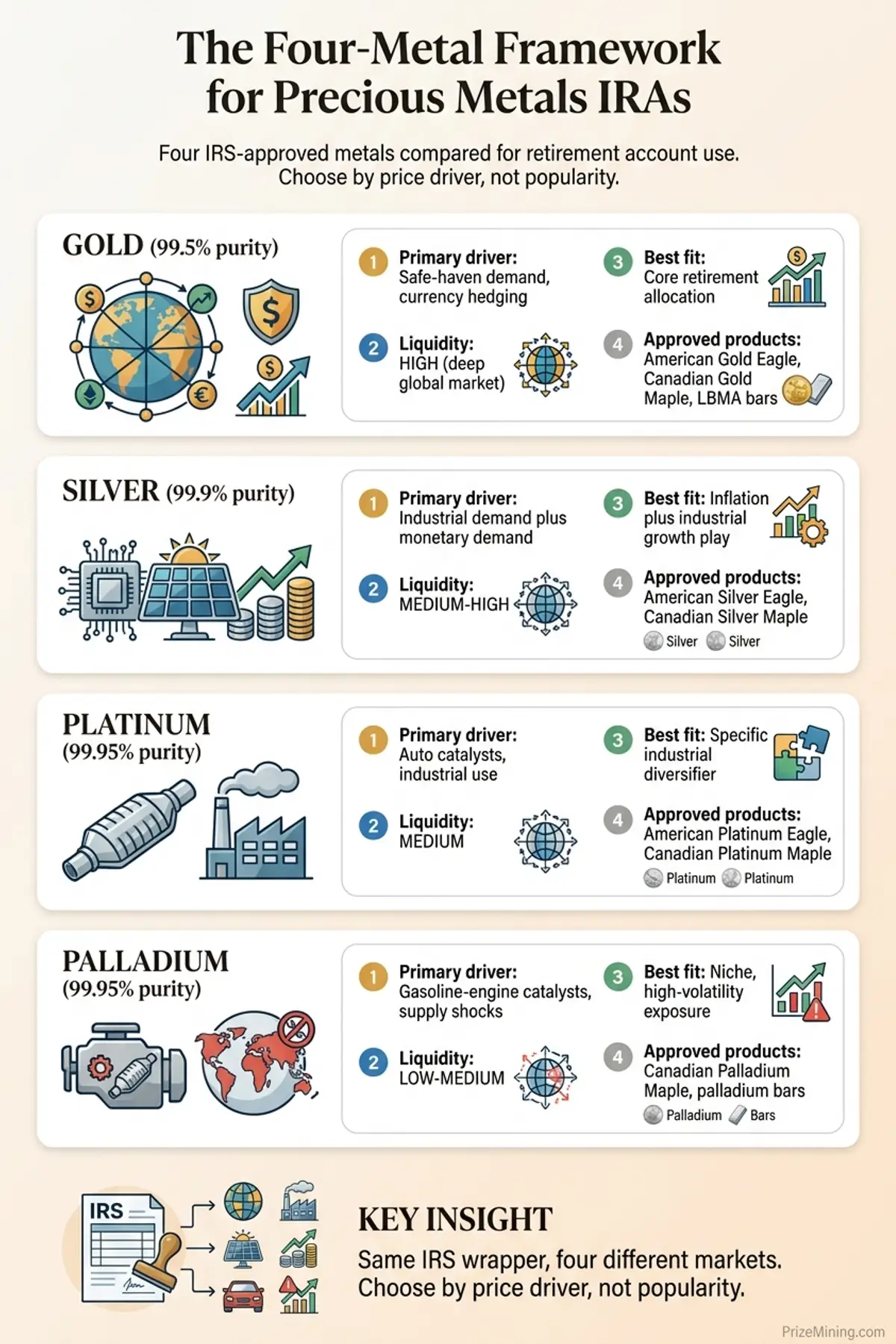
A Precious Metals IRA is a self-directed retirement account that holds physical gold, silver, platinum, or palladium instead of paper securities. The IRS defines which products qualify under 26 U.S. Code Section 408(m), and the metals must be stored at an approved depository — not at home (Source: 26 U.S. Code § 408). The account type allows four different metals with distinct price behavior and liquidity profiles. The Four-Metal Framework below shows how each metal compares on purity, price driver, liquidity, and use-case fit.
Over the past two years, we have catalogued more than 200 IRS-eligible coin and bar products across all four metals to build the framework on this page.
Key Takeaways
- A Precious Metals IRA holds physical gold, silver, platinum, or palladium in a self-directed retirement account.
- All four metals follow the same IRS tax rules but have very different price behavior and liquidity.
- The choice of metal matters almost as much as opening the account itself.
How does a Precious Metals IRA differ from a Gold IRA?
A Precious Metals IRA is the broader category. A Gold IRA is one type of Precious Metals IRA — the version that holds only gold. The account structure, custodian requirements, and tax rules are identical. The only difference is which metals sit inside.
Think of it like a car category versus a specific model. "Precious Metals IRA" is the category, like "sedan." "Gold IRA" is one model within that category. The engine, frame, and road rules are the same — only the trim changes.
For a focused look at the gold-only version, our Gold IRA mechanics overview walks through the full account setup. The rest of this page covers what changes when you add the other three metals to the same wrapper.
Which four metals qualify?
Four precious metals qualify under 26 U.S. Code Section 408(m): gold, silver, platinum, and palladium. Each has a minimum purity requirement and a list of approved products (Source: IRS).
| Metal | Minimum Purity | Common Approved Products | Typical Role |
|---|---|---|---|
| Gold | 99.5% (0.995) | American Gold Eagle*, Canadian Gold Maple, gold bars (LBMA) | Core allocation, most liquid |
| Silver | 99.9% (0.999) | American Silver Eagle, Canadian Silver Maple, silver bars | Industrial exposure + inflation hedge |
| Platinum | 99.95% (0.9995) | American Platinum Eagle, Canadian Platinum Maple | Industrial demand, niche diversifier |
| Palladium | 99.95% (0.9995) | Canadian Palladium Maple, palladium bars | Auto-industry exposure, volatile |
*The American Gold Eagle is a statutory exception at 91.67% purity, explicitly permitted by 26 U.S. Code § 408(m)(3)(A)(i) (Source: U.S. Mint).
Collectibles, numismatic coins, rare commemoratives, and jewelry are all prohibited. Buying them with IRA funds triggers a taxable distribution under 26 U.S. Code § 408(m). The eligible metals reference lists every approved product by mint and purity.
What is the four-metal framework?
Each metal plays a different role inside the same IRA wrapper. Price drivers, liquidity, and typical investor use cases all vary by metal. The framework below shows where each metal tends to fit.
| Metal | Primary Price Driver | Liquidity | Best Fit |
|---|---|---|---|
| Gold | Safe-haven demand, currency hedging | High | Core retirement allocation |
| Silver | Industrial demand + monetary demand | Medium-high | Inflation + industrial growth play |
| Platinum | Auto catalysts, industrial use | Medium | Specific industrial diversifier |
| Palladium | Gasoline-engine catalysts, supply shocks | Low-medium | Niche, high-volatility exposure |
Gold behaves like a long-term stabilizer — it moves slowly, has deep global markets, and tends to hold value through currency stress. Silver mixes monetary and industrial demand, which makes it more volatile but also responsive to manufacturing cycles. Platinum and palladium are dominated by auto-industry demand, so their prices track catalytic converter trends and supply shocks from major producers like Russia and South Africa.
How does a Precious Metals IRA work in practice?
Four parties handle every Precious Metals IRA: you (the account owner), a custodian, a dealer, and a depository. The process is the same whether the account holds gold alone or all four metals.
- Open the account. Choose a self-directed IRA custodian licensed to hold precious metals. The custodian sets up the account and handles the paperwork.
- Fund the account. Roll over a 401(k) or existing IRA, or make a direct contribution. Direct trustee-to-trustee transfers avoid the 60-day indirect rollover risk.
- Select metals. Work with the dealer to choose IRS-approved products. Compare dealer markups between at least three providers before buying.
- Ship to depository. The dealer ships the metals directly to the IRS-approved depository. You never handle them personally.
- Monitor and manage. The custodian sends annual statements. You can sell, add, or eventually distribute the metals at retirement age.
This runs like a well-sequenced relay race — each party handles their leg and passes the baton. If any step breaks (for example, the dealer ships to your home instead of the depository), the account loses its tax-advantaged status. The five-step Gold IRA overview covers each party's role in depth.
How much does a Precious Metals IRA cost?
A Precious Metals IRA typically costs 3 to 13 percent of your account balance in the first year (Source: IRS Publication 590-A). Fees come in four layers, and all four apply regardless of which metals you choose. Think of the fee stack like a flight ticket: the base fare is only part of the picture once baggage, seat selection, and taxes are added. The total is what matters, not any single line item.
| Fee Type | Typical Range | Frequency |
|---|---|---|
| Setup fee | $50 – $200 | One-time |
| Annual custodian fee | $75 – $300 | Yearly |
| Storage & insurance | $100 – $300/year | Yearly |
| Dealer markup | 3% – 10% above spot | Per purchase |
Smaller coins and fractional products typically carry higher dealer markups than full-ounce bars. That matters when choosing silver — one-ounce silver coins often have 15 to 30 percent premiums over spot, while 100-ounce silver bars sit closer to 3 to 5 percent (Source: LBMA Good Delivery List). The Gold IRA fee breakdown applies equally to Precious Metals IRAs across all four metals.
Also worth noting: dealer markups stack on top of the custodian and storage fees, which means every new purchase adds a fresh cost layer. Our fee estimator projects the total cost across different account sizes and time horizons.
When does a Precious Metals IRA make sense?
A Precious Metals IRA tends to work best as a limited allocation inside a broader retirement plan, not as a replacement for a Traditional IRA or 401(k). However, specific situations make the fee load worth the physical-asset exposure.
- You want physical-metal diversification. A 5 to 10 percent allocation alongside stocks and bonds gives you exposure to metals that move differently from paper assets.
- You have at least $50,000 to allocate. Fixed custodian and storage fees consume 1 to 2 percent per year on smaller accounts, making the math difficult below that threshold.
- You have a long time horizon. Ten-plus years lets metal appreciation absorb the fee drag that physical holding creates.
- You want exposure to multiple metals. Silver, platinum, or palladium are hard to access through mainstream brokerage IRAs in physical form. A Precious Metals IRA is often the simplest wrapper for multi-metal allocations.
When does a Precious Metals IRA not make sense?
A Precious Metals IRA does not fit every situation. A gold ETF inside a Traditional IRA delivers similar price exposure at 0.17–0.40% per year — versus 0.5–1.5% per year for a Precious Metals IRA — without storage overhead, dealer markup, or buyback spread. Five scenarios point toward the simpler ETF structure rather than the physical wrapper.
- Your retirement savings are under $50,000. Fixed fees hit smaller accounts disproportionately. A gold ETF inside a Traditional IRA delivers similar exposure at a fraction of the cost.
- You need quick access to cash. Selling physical metals takes 5 to 15 business days and involves dealer buyback spreads.
- You are within 5 years of retirement and need RMD flexibility. Required minimum distributions against physical metal require sales or in-kind distributions, both of which add cost.
- You want a set-and-forget portfolio. Dollar-cost averaging into a Precious Metals IRA triggers a new dealer markup on every purchase.
For a side-by-side look at the alternative, see our Gold IRA vs Traditional IRA comparison.
What are common mistakes when choosing metals?
Early in our review work in 2024, we assumed most complaints would center on the account structure itself. After reviewing 200-plus product listings and matching them against complaint files, we found that product selection — especially silver coin markups and numismatic upsells — drove more investor harm than structural issues. The mistakes below show up most often.
- Buying numismatic or "rare" coins for the IRA. These are prohibited under 26 U.S. Code 408(m), and dealers promoting them face enforcement risk. Stick to IRS-approved bullion products only.
- Concentrating in one metal without a reason. Most investors buy only gold out of habit. Silver, platinum, or palladium can add diversification if you understand each metal's price driver.
- Overpaying for fractional coins. Half-ounce and quarter-ounce gold coins can carry 10 to 15 percent higher markups than full ounces. For IRA holdings, full ounces or bars usually win on cost.
- Skipping the spot-price check. Any dealer markup should be quoted explicitly as a percentage above spot price. "Good value" or "market price" without a spot reference is a red flag.
- Rolling over a full Traditional IRA. This concentrates fees and volatility in a single asset class. Most planners recommend staying at 5 to 10 percent of total retirement assets.
Note: Confusion Entity
A Precious Metals IRA is not the same as owning physical metals personally. A Precious Metals IRA holds IRS-approved bullion at an approved depository, with tax-deferred or tax-free growth depending on the account variant. Personally owned gold or silver kept at home has no tax advantage, no IRS restrictions on product type, and no contribution limits — but also no retirement tax wrapper.
What Does the Research Show?
Academic research on precious metals in retirement portfolios consistently finds that small allocations improve portfolio diversification without meaningfully reducing long-run returns. Gold shows low correlation with US equities over long horizons, and silver adds moderate industrial exposure (Source: SEC Investor Alert for broader self-directed IRA context).
The limitation: most studies compare metals to stocks in a brokerage account, not inside a fee-heavy self-directed IRA wrapper. Our own review of fee schedules suggests that the break-even allocation for physical metal exposure is higher when you factor in custodian, storage, and markup costs. A 3 percent allocation in a brokerage account may need to be 5 to 10 percent inside a Precious Metals IRA to justify the fee load.
When should you talk to a specialist?
A fee-only CERTIFIED FINANCIAL PLANNER™ earns the most value when the allocation decision crosses certain thresholds.
- You are considering an allocation above 15 percent. At that level the decision shifts from diversification to concentrated bet on metals — specialist input is worth the hourly rate.
- You want multi-metal allocations. Platinum and palladium have narrower markets than gold and silver; a specialist can model the liquidity trade-off.
- You are rolling over a large 401(k). Combining rollover mechanics with metal selection is complex — see also our rollover process overview before initiating.
- You are within 10 years of retirement. Near-retirement liquidity planning makes the Precious Metals IRA's settlement timeline matter more than it does for younger investors.
Frequently Asked Questions
What is the difference between a Precious Metals IRA and a Gold IRA?
A Precious Metals IRA is the broader category that includes gold, silver, platinum, and palladium. A Gold IRA is a Precious Metals IRA that holds only gold. The account structure, custodian rules, and tax treatment are identical. The difference is just which metals are held inside.
Which metals qualify for a Precious Metals IRA?
Four metals qualify under 26 U.S. Code Section 408(m): gold at 99.5% purity or higher, silver at 99.9%, platinum at 99.95%, and palladium at 99.95%. The American Gold Eagle is a statutory exception at 91.67% purity. Collectibles, numismatic coins, and jewelry are prohibited.
Can I hold all four metals in the same IRA?
Yes. A single Precious Metals IRA can hold any combination of IRS-approved gold, silver, platinum, and palladium. The same custodian and depository handle all four. Most investors start with gold and silver and add platinum or palladium only for specific diversification reasons.
How much does a Precious Metals IRA cost?
Setup fees run $50 to $200. Annual custodian fees are $75 to $300. Storage and insurance add $100 to $300 per year. Dealer markups on metal purchases range from 3% to 10% above spot price, depending on the metal and product. Total first-year cost is typically 3% to 13% of the account balance.
The Bottom Line
What is the four-metal framework? is the most useful way to think about a Precious Metals IRA. Gold is the core, silver adds industrial exposure, and platinum and palladium fill specific diversification roles. All four share the same IRS wrapper, the same custodian and depository structure, and the same fee layers. The choice of metal matters almost as much as the choice to open the account.
For most investors, that means starting with gold and silver, limiting the total allocation to 5 to 10 percent of retirement assets, and paying close attention to dealer markups on every purchase. If you are weighing which metals to hold, start with the spot price vs premium overview to see how pricing works across different products. The full Precious Metals hub covers eligibility, pricing, and the broader context, and our scoring methodology explains how we evaluate each structure.
James Hartley
Former financial journalist (8 years) · Series 65 license holder
James covers retirement planning and precious metals investing. He spent eight years as a financial journalist before joining PrizeMining to research Gold IRA providers, fee structures, and regulatory requirements.
Sources
- 1.26 U.S. Code § 408 — Individual Retirement AccountsRegulation
- 2.IRS — Investments in Collectibles in IRAsOfficial
- 3.IRS Publication 590-A — Contributions to IRAsOfficial
- 4.LBMA Good Delivery List — GoldOfficial
- 5.LBMA Good Delivery List — SilverOfficial
Gold IRA Due Diligence Checklist
10 items to verify before you open an account: fee transparency, custodian credentials, storage terms, buyback policies, and more. Free PDF, straight to your inbox.
No spam. Unsubscribe anytime. We never share your email.
This content is for informational purposes only and does not constitute financial, investment, or tax advice. Gold IRAs carry risks including price volatility, limited liquidity, and fees that can erode returns. Always consult a qualified financial advisor before making retirement investment decisions.