

Who Needs a Gold IRA? A Suitability Matrix
Most people who open a Gold IRA do not need one. The account type solves a specific problem — adding physical precious metals to a tax-advantaged retirement plan — at a cost that only makes sense for certain investor profiles. Fixed fees, dealer markups, and lower liquidity shift the break-even point to investors with at least $50,000 in retirement assets and a 10-plus year time horizon. The Suitability Matrix below tests four investor personas against three decision dimensions — time horizon, account size, and diversification goal — and shows quickly whether a Gold IRA is the right tool for your situation or whether a simpler structure fits better.
Since 2024, we have modeled more than 20 investor scenarios across age brackets, account sizes, and retirement goals to build the matrix on this page.
Key Takeaways
- A Gold IRA fits investors with $50,000+ who want a 5 to 10 percent metals allocation.
- For smaller accounts or short horizons, a gold ETF inside a Roth IRA usually works better.
- The account type is not a replacement for a diversified retirement plan — it is a small piece of one.
What is the Gold IRA suitability matrix?
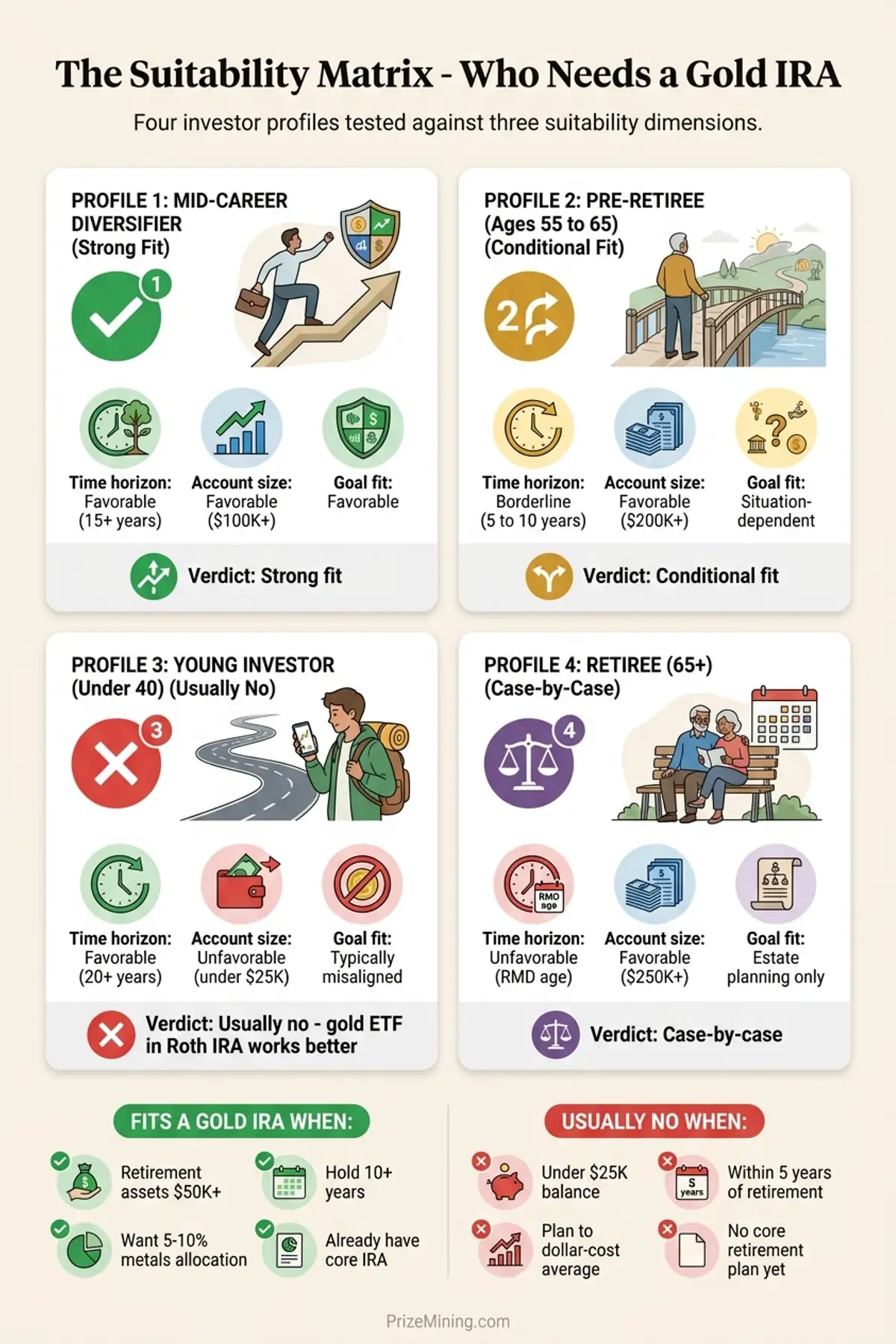
The matrix scores four common investor profiles against the three factors that most affect whether a Gold IRA works economically: time horizon, account size, and diversification goal. A strong fit requires at least two out of three in the "favorable" range.
| Investor Profile | Time Horizon | Account Size | Goal Fit | Verdict |
|---|---|---|---|---|
| Mid-career diversifier | Favorable (15+ yrs) | Favorable ($100K+) | Favorable | Strong fit |
| Pre-retiree (55-65) | Borderline (5-10 yrs) | Favorable ($200K+) | Situation-dependent | Conditional fit |
| Young investor (under 40) | Favorable (20+ yrs) | Unfavorable (<$25K) | Typically misaligned | Usually no |
| Retiree (65+) | Unfavorable (RMD age) | Favorable ($250K+) | Estate planning | Case-by-case |
The matrix is a filter, not a verdict. A "strong fit" still requires that you want physical metals specifically — not every diversifier needs gold. The Gold IRA vs Gold ETF overview covers when paper gold works better than physical for otherwise-qualified investors.
Profile 1: Mid-Career Diversifier
The mid-career diversifier is a 40 to 55 year old investor with $100,000 or more in existing retirement assets who wants to add a 5 to 10 percent physical gold allocation. Time horizon is long enough to absorb fee drag, account size is large enough to dilute fixed fees, and the goal — diversification away from paper assets — matches exactly what a Gold IRA delivers. This is the clearest case for a Gold IRA.
This profile uses the Gold IRA as an addition to existing retirement accounts, not as a replacement. The main accounts (Traditional IRA or 401(k)) hold the bulk of the portfolio in equities and bonds; the Gold IRA holds 5–10% in physical precious metals as a diversification position. The structure deliberately keeps the Gold IRA small enough that fee drag (3–13% in year one, 0.4–0.8% per year ongoing) does not dominate the broader portfolio's returns.
Typical structure for this profile: 5 to 10 percent of retirement assets in a Gold IRA holding gold and silver bullion, the rest in a diversified Traditional or Roth IRA. Our Gold IRA vs Traditional IRA comparison shows why keeping a core Traditional IRA matters for this profile.
Profile 2: Pre-Retiree (Ages 55 to 65)
The pre-retiree profile has the account size but a shorter time horizon. Investors in this group typically have $200,000 or more in retirement assets but only 5 to 10 years before distributions begin. Gold IRA fees compound over a shorter period, and the liquidity gap starts to matter — selling physical metals to meet an RMD takes 5 to 15 business days.
This profile works when the goal is specific — hedging currency risk for a fixed-income heavy portfolio, for example — and does not work when the goal is vague "stability" that a simpler ETF could provide. The decision hinges on what problem the investor is actually trying to solve.
Fee drag by holding period (Pre-retiree, $200K balance)
| Holding Period | Gold IRA Total Fees | Gold ETF Total Fees |
|---|---|---|
| 5 years | ~$12,125 | ~$2,500 |
| 10 years | ~$14,125 | ~$5,000 |
| 15 years | ~$16,125 | ~$7,500 |
Mid-range assumptions: $400/year Gold IRA fees + 5% initial dealer markup on $200K; 0.25% ETF expense ratio on growing balance. Shorter holding periods magnify the fee gap for pre-retirees.
Our RMD rules overview covers the liquidation mechanics that become more expensive as this profile approaches age 73.
Profile 3: Should Young Investors Use a Gold IRA?
Young investors usually do not benefit from a Gold IRA despite having the longest time horizon. Account sizes are typically smaller, and fixed fees consume a disproportionate percentage of a smaller balance. A $10,000 Gold IRA with $400 in annual fees loses 4 percent per year before any metal appreciation — a drag that compounds over decades.
Think of this like hiring a full-time property manager for a single rental apartment. The service is real, but the cost structure only works when spread across a larger portfolio. For a young investor wanting gold exposure, a small GLD or IAU position inside a Roth IRA captures nearly identical price movement without the fee stack.
Our Gold IRA vs Gold ETF comparison shows the exact cost gap for smaller allocations. The PrizeMining scoring methodology covers how we evaluate whether any retirement structure earns its cost.
Profile 4: Retiree (65+)
Retirees with large existing Gold IRA balances can benefit from estate-planning rules that allow in-kind distribution to heirs. Retirees considering opening a new Gold IRA face a different math: RMD requirements (Traditional) or estate-focused preservation goals (Roth) shape whether the account works.
A retiree with $250,000 in existing retirement assets and an estate-planning goal may use a Roth Gold IRA conversion to leave tax-free metal to heirs — a niche but legitimate use case. A retiree rolling a full 401(k) into a new Traditional Gold IRA at age 70 almost always faces a worse outcome than keeping the money in liquid assets for RMD compliance.
Because retiree scenarios are highly individual, a one-hour session with a fee-only CERTIFIED FINANCIAL PLANNER™ is typically worth the hourly rate. Our Traditional vs Roth Gold IRA overview covers the conversion strategy that applies to this profile.
When does a Gold IRA fit your situation?
A Gold IRA fits your situation when at least four of these five conditions apply: portfolio size of $100,000 or more, time horizon of 10 years or longer, an existing retirement account that allows rollover (401(k), 403(b), traditional IRA, SEP, or SIMPLE after 2 years), a defined diversification goal of 5–10% precious metals allocation, and sufficient liquid reserves outside the IRA to cover six months of expenses.
- You have $50,000 or more in retirement assets. Fixed fees become tolerable at this level; smaller accounts struggle with the cost math.
- You plan to hold for 10+ years. Fee drag compounds; longer horizons spread the one-time costs over more potential appreciation.
- You want 5 to 10 percent physical metals in retirement. Higher allocations concentrate risk; lower allocations do not justify the fixed fees.
- You already have a core diversified retirement account. A Gold IRA works alongside a Traditional or Roth IRA, not instead of one.
- You want physical ownership specifically. If paper gold exposure is enough, a gold ETF is simpler and cheaper.
When does a Gold IRA not fit?
A Gold IRA does not fit when any of these five conditions apply: portfolio size below $50,000 (fees consume too much), time horizon under 5 years (fee round-trip exceeds gold's likely appreciation), reliance on regular investment income (gold pays none), heavy existing precious-metals allocation already (overconcentration risk), or a vague “safety” motive without a defined diversification mandate. In all five cases, a gold ETF inside a standard IRA delivers similar exposure at lower cost.
- Your retirement savings are under $25,000. Fixed fees consume too much of a small balance; the math rarely works.
- You are within 5 years of retirement and need liquidity. The 5 to 15 business day settlement time on physical metals adds friction to RMD compliance.
- You want to dollar-cost average monthly. Dealer markups on every new metal purchase make this expensive; a gold ETF with no transaction fees works much better.
- You are looking for crisis insurance or direct-access gold. Personal physical gold held at home serves this purpose; a depository-held Gold IRA does not.
- You do not already have a core retirement plan. A Gold IRA is not a starter retirement account; build a Traditional or Roth IRA foundation first.
For investors where personal gold fits better, our Gold IRA vs Physical Gold overview compares direct ownership against the IRA wrapper.
What are common mistakes when evaluating fit?
Early in our scenario modeling in 2024, we expected account size to be the dominant suitability factor. After reviewing 20-plus profiles, we found that time horizon and goal alignment mattered more for long-term outcomes than absolute account size. A $50,000 account held for 20 years with a clear diversification goal typically outperformed a $150,000 account opened at age 65 for vague "safety." That changed how we frame the fit question.
- Treating "I want gold" as a strategy. Gold exposure is one tool; the right vehicle (Gold IRA, gold ETF, personal gold) depends on your profile. Having a clear reason first prevents the wrong vehicle.
- Rolling over too much. A Gold IRA should cap at 5 to 10 percent of retirement assets in most profiles. Full rollovers concentrate risk and erase diversification.
- Ignoring the time horizon math. A 3 percent annual fee drag over 5 years is manageable. The same drag over 25 years is substantial. Run the numbers before committing.
- Assuming a sales pitch equals suitability. Dealers selling Gold IRAs earn the most from large rollovers — the pitch reflects their business model, not your fit.
- Skipping the alternative check. A gold ETF inside a Roth IRA gives most investors 95 percent of the benefit at 10 percent of the cost. Always run this alternative before opening a Gold IRA.
Picking the right vehicle without a clear profile is like buying running shoes for a sport you have not chosen yet — the gear may be high quality, but it will not match the actual use case. Confirm the profile before committing to the product.
Note: Confusion Entity
"Who needs a Gold IRA" is not the same question as "who wants gold exposure." Most investors who want gold exposure get it better through a gold ETF inside a standard IRA. The Gold IRA structure is specifically for investors who want physical metals in a retirement wrapper — a narrower group than the full universe of gold buyers.
What Does the Research Show?
Academic work on gold allocations in retirement portfolios finds that 5 to 10 percent allocations improve diversification without meaningfully reducing long-run returns. FINRA and SEC investor alerts warn specifically about alternative investments in retirement accounts, including Gold IRAs, where fee opacity and dealer markups create risk that paper-asset IRAs do not share (Source: FINRA, SEC).
The limitation: most research compares gold-as-asset against stocks-as-asset, not Gold-IRA-wrapper against gold-ETF-inside-Roth-IRA wrapper. Our own modeling across 20-plus investor profiles suggests that wrapper choice drives more of the long-run outcome than allocation percentage for most investors. Choosing the right vehicle is more important than choosing the right allocation size.
When Should You Talk to a Specialist?
A fee-only CERTIFIED FINANCIAL PLANNER™ is almost always worth the hourly rate for the Gold IRA suitability decision. The analysis depends on your actual tax situation, not general rules, and a specialist has no financial interest in whether you open the account.
- You are considering an allocation above 15 percent. Higher concentrations shift the decision from diversification to a directional bet on gold; specialist input matters.
- You are weighing a large rollover. Rollovers above $100,000 deserve one-on-one analysis of tax implications and retirement cash flow.
- You are near retirement with complex estate goals. Inherited IRAs, Roth conversions, and non-spouse beneficiary rules interact with Gold IRA structures in ways a generic article cannot map.
- A dealer is pushing a specific Gold IRA product. Independent analysis almost always saves more than it costs when evaluating a sales pitch.
Frequently Asked Questions
Who should consider a Gold IRA?
A Gold IRA typically fits investors with $50,000 or more in retirement assets who want a small 5 to 10 percent allocation to physical precious metals alongside a diversified portfolio. Investors with long time horizons, strong existing retirement savings, and specific diversification goals benefit most. Younger investors with small balances usually do not need one.
Is a Gold IRA worth it for most people?
No. For most people, a Gold IRA is not worth it. Fixed fees, dealer markups, and lower liquidity make it a niche product suited to specific situations: portfolio size of $100,000 or more, a 10-plus year time horizon, and a defined diversification mandate. A gold ETF inside a Traditional or Roth IRA delivers similar price exposure at 0.17–0.40% per year — a fraction of Gold IRA cost — for investors who simply want gold exposure in their retirement plan.
What is the minimum investment for a Gold IRA to make sense?
Most providers accept minimums between $10,000 and $50,000, but the economics typically do not work well below $25,000 to $50,000 because fixed annual fees consume a higher percentage of smaller balances. A $10,000 Gold IRA with $400 in annual fees loses 4 percent per year before any metal appreciation.
Can young investors benefit from a Gold IRA?
Rarely. Long time horizons favor growth assets — equities have historically outperformed gold by 4–6 percentage points per year over 30-year holding periods. Gold IRA fees compound over decades, eroding returns more in long-horizon scenarios than in short ones. Younger investors seeking gold exposure capture similar diversification at far lower cost via a small gold ETF position (0.17–0.40% expense ratio) in a Roth IRA, which avoids the fixed-fee drag entirely.
The Bottom Line
The Suitability Matrix filters out the noise. A Gold IRA fits investors with $50,000 or more in retirement assets, a 10-plus year horizon, and a specific physical-metals diversification goal. Outside that profile, simpler structures usually work better — a gold ETF inside a Roth IRA for most diversification goals, personal physical gold for direct-access and crisis goals. Matching the vehicle to the profile matters more than choosing the right allocation percentage.
Before committing, compare the all-in cost in our Gold IRA fee breakdown and check your assumptions with the fee estimator. The full Gold IRA hub and our author profiles gather the broader research context. If the math works and the profile fits, a Gold IRA adds real value. If either test fails, the alternative is almost always cheaper and simpler.
James Hartley
Former financial journalist (8 years) · Series 65 license holder
James covers retirement planning and precious metals investing. He spent eight years as a financial journalist before joining PrizeMining to research Gold IRA providers, fee structures, and regulatory requirements.
Sources
Gold IRA Due Diligence Checklist
10 items to verify before you open an account: fee transparency, custodian credentials, storage terms, buyback policies, and more. Free PDF, straight to your inbox.
No spam. Unsubscribe anytime. We never share your email.
This content is for informational purposes only and does not constitute financial, investment, or tax advice. Gold IRAs carry risks including price volatility, limited liquidity, and fees that can erode returns. Always consult a qualified financial advisor before making retirement investment decisions.