

Gold IRA vs Physical Gold — Which Ownership Path Fits?
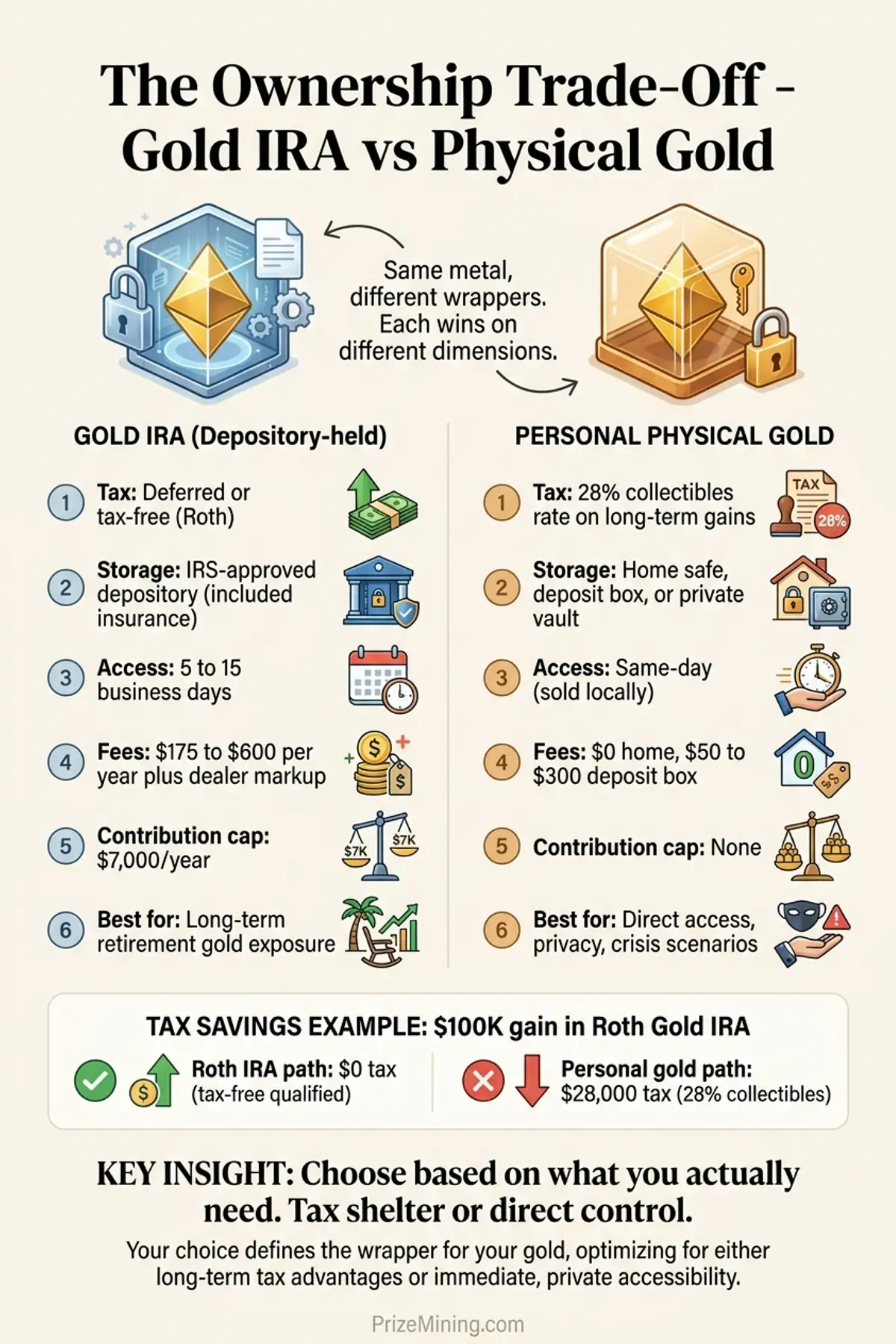
Owning gold through a Gold IRA and owning gold directly are two different answers to the same question. A Gold IRA holds the metal inside a tax-advantaged retirement wrapper at an IRS-approved depository. Physical gold owned personally sits in a home safe, a safe deposit box, or a private vault — under your direct control, but with no tax shelter. Long-term gains on personally held gold are taxed at the 28% collectibles rate, while gold inside an IRA avoids that rate entirely (Source: IRS Topic 409). We call the framework The Ownership Trade-Off: direct control versus tax advantage, with each path strong where the other is weak.
Since 2024, we have compared the tax, storage, and access trade-offs across more than 15 investor scenarios to build the framework on this page.
Key Takeaways
- A Gold IRA offers tax advantages and regulatory oversight; personal physical gold offers direct control.
- You cannot legally mix the two — IRA gold must be held at an approved depository.
- The right choice depends on whether tax savings or direct access matters more for your situation.
What is the core difference between a Gold IRA and physical gold?
The core difference is who controls the metal and whether the IRS offers tax benefits. A Gold IRA holds gold under the rules of 26 U.S. Code Section 408(m), which requires a qualified custodian and an approved depository. Personal physical gold has no such requirements — you own it outright, store it where you want, and can sell it on your own terms.
Think of the choice like owning a second home versus renting a vacation condo. The second home gives you control, personalization, and direct equity, but you handle maintenance, insurance, and resale. The condo gives you professional management, predictable costs, and easier exit, but less control over the property. Gold IRAs and personal gold follow the same pattern — control on one side, structure on the other.
The Gold IRA structure is covered in depth in our Gold IRA mechanics overview. Home storage of personal gold is distinct from the banned "home storage Gold IRA" scheme — see our home storage overview for why that structure fails.
How does a Gold IRA compare to physical gold side-by-side?
The practical differences show up in taxes, storage, access, and risk. The same metal behaves very differently depending on which wrapper holds it.
| Feature | Gold IRA | Personal Physical Gold |
|---|---|---|
| Ownership structure | Held by custodian at approved depository | Held directly by you |
| Tax on long-term gains | Ordinary income (Traditional) or tax-free (Roth) | 28% collectibles rate |
| Contribution limit | $7,000/year ($8,000 if 50+) | None |
| Eligible products | IRS-approved bullion only (99.5%+ purity) | Any gold product, including numismatic |
| Storage | Approved depository (required) | Home safe, safe deposit box, or private vault |
| Annual fees | $175 – $600 (custodian + storage) | $0 home / $50 – $300 safe deposit box |
| Access speed | 5 – 15 business days to sell | Same-day if sold locally; longer for coin shops |
| Insurance | Included at depository | Separate homeowners rider or private policy |
| Reporting to IRS | Annual custodian reporting | Only on sale (if gains trigger Form 1099-B) |
How does the tax math compare for a $100,000 scenario?
On a $100,000 gold position doubling to $200,000 over 20 years, the tax treatment creates a meaningful gap between the two paths. The IRA wrapper delivers tax savings the personal path cannot match.
| Scenario | Tax on $100K Gain | Net After Tax |
|---|---|---|
| Personal physical gold | $28,000 (28% collectibles rate) | $172,000 |
| Traditional Gold IRA (22% retirement bracket) | $44,000 on full $200K | $156,000 |
| Roth Gold IRA | $0 on qualified withdrawal | $200,000 |
Simplified model. Traditional IRA scenario taxes full $200K at 22% marginal bracket. Roth assumes qualified withdrawal after age 59 and a half. Ignores fees on both paths.
The math flips depending on the account type and retirement bracket. A Roth Gold IRA wins decisively on long-term appreciation. A Traditional Gold IRA can lose to personal ownership if your retirement bracket is higher than the 28% collectibles rate. Personal physical gold is the middle path — predictable tax, no contribution limit, but no tax shelter either. The Traditional vs Roth Gold IRA overview covers the wrapper-level choice in more detail.
How do storage and physical security compare?
Storage is the most visible difference between the two paths. A Gold IRA must use an approved depository with documented insurance and audited vault procedures. Personal gold can go anywhere you choose — but every option comes with different trade-offs.
| Storage Option | Typical Cost | Access | Insurance |
|---|---|---|---|
| Gold IRA depository | $100 – $300/year | Business days, with notice | Included |
| Home safe | $0 ongoing | Immediate | Homeowners rider needed |
| Bank safe deposit box | $50 – $300/year | Bank hours only | Not FDIC insured |
| Private vault | $150 – $500/year | Business days | Typically included |
Safe deposit boxes look like the cheapest personal option, but most homeowners insurance does not cover their contents, and banks explicitly disclaim FDIC coverage for box contents (Source: Investopedia). A separate rider or specialty policy is typically needed. For home storage, standard homeowners policies cap precious-metals coverage at around $1,000 to $2,500 — a fraction of what a serious gold position is worth.
A home safe deters opportunistic theft but offers limited protection against a determined burglar. Most residential burglary-rated safes are defeated in under 30 minutes by a prepared intruder using power tools — which is why the insurance industry caps homeowner coverage on precious metals at $1,000–$2,500 per policy without a costly schedule rider. For allocations above $10,000, depository storage at $100–$300/year delivers stronger protection than home storage even outside a Gold IRA.
How do access, privacy, and crisis scenarios compare?
Personal physical gold wins on access and privacy. You can sell at a local coin shop, gift it without paperwork, or keep it during an emergency where banks or depositories are unavailable. A Gold IRA requires custodian involvement for every transaction and generates annual IRS reporting through the custodian.
Access flexibility matters most when the normal financial system is disrupted. Personal physical gold settles instantly without a middleman. A Gold IRA depends on the custodian remaining operational and on you having access to communications channels and notarization. For investors who hold gold specifically as crisis insurance, the access difference is a meaningful trade-off — the IRA tax advantages come at the cost of immediate physical access during a crisis.
On the other hand, personal ownership increases the risk profile. Physical gold is portable, valuable, and untraceable — exactly the features that make it a theft target. A Gold IRA removes that risk by holding metal in a vault you never physically access. Our Gold IRA risks overview covers the broader risk comparison across both paths, and the rollover overview shows how to move existing retirement assets into a Gold IRA if the structure fits.
When does a Gold IRA make more sense than physical gold?
A Gold IRA wins when tax efficiency, regulatory protection, and retirement integration matter more than direct access.
- You want retirement-focused gold exposure. A Gold IRA fits inside a retirement plan alongside stocks and bonds, with tax-advantaged growth and coordinated RMD planning.
- You have a long time horizon (10+ years). The 28% collectibles tax on personal gold applies only at sale, but compounds over long horizons. The IRA wrapper sidesteps it entirely.
- You are concerned about theft or loss. Depository storage eliminates the risk of home theft, fire, flood, or misplacement — risks that insurance rarely covers in full for large gold positions.
- Your allocation is $50,000 or more. Gold IRA fixed fees are easier to absorb on larger accounts, and the tax savings compound more meaningfully.
When does personal physical gold make more sense?
Personal physical gold wins when direct control, privacy, or crisis-use cases matter more than tax efficiency.
- You want actual possession. If holding metal you can see and touch is part of your reasoning for owning gold, a depository-held Gold IRA misses the point.
- You hold gold for crisis scenarios. Physical gold you control directly is independent of custodians, banks, and financial infrastructure. That value only exists if you actually hold the metal.
- You want to give or inherit gold outside retirement rules. Gifting or inheriting personal gold follows standard estate rules. IRA assets follow retirement distribution rules that may not match your wishes.
- Your allocation is small or short-term. A $5,000 personal gold position carries no fixed fees. The same amount in a Gold IRA is crushed by annual custodian costs.
- You want to buy products outside IRA eligibility. Numismatic coins, rare collectibles, and non-standard products are prohibited in IRAs but fine for personal ownership.
What are common mistakes when choosing between them?
Early in our scenario work in 2024, we expected the tax treatment gap to be the decisive factor in most cases. After reviewing 15-plus investor profiles, we found that storage logistics and access needs drove more real-world decisions than the tax math — most investors eventually picked the path that matched how they actually wanted to use the gold, not the path with the best tax outcome. The mistakes below show up most often.
- Trying to mix the two structures. You cannot store Gold IRA metals at home. The "home storage Gold IRA" LLC scheme was rejected by the Tax Court in McNulty v. Commissioner (2021), triggering over $270,000 in taxes and penalties for the taxpayer.
- Underestimating home storage insurance gaps. Standard homeowners insurance caps precious-metals coverage at $1,000 to $2,500. A serious gold position needs a separate rider or private policy.
- Ignoring the collectibles tax on personal gold. The 28% rate surprises many investors at sale. Factor it into the return calculation before comparing to IRA scenarios.
- Choosing based on account size alone. A $20,000 Gold IRA is usually too small to justify fixed fees. A $20,000 personal gold position is easy to store and privacy-friendly.
- Assuming you can switch structures later. Moving personal gold into a Gold IRA is not straightforward — the metals must be sold, rolled over as cash, and repurchased through a dealer at dealer-markup prices. Plan the structure before buying, not after.
Note: Confusion Entity
Owning physical gold at home is not the same as a "home storage Gold IRA." Personal gold owned with after-tax money is perfectly legal and has no IRS storage rules. A "home storage Gold IRA" is a promoted scheme where an LLC owned by an IRA buys metals stored at home — rejected by the U.S. Tax Court and treated as a full taxable distribution. The difference is the account type, not the location of the gold.
What Does the Research Show?
Academic and regulatory research on gold ownership consistently finds that tax wrappers matter more for long-horizon holdings than for short-term trading. The 28% collectibles tax rate adds a meaningful drag on personal gold held more than a year, while IRA wrappers eliminate that drag entirely (Source: IRS Topic 409). SEC investor alerts also note that custodian-based structures offer regulatory oversight that personal storage lacks (Source: SEC Investor Alert).
The limitation: most research assumes average fee levels on the IRA side. Our own review suggests that dealer markups above 6 percent can erase the tax advantage for holding periods under 10 years. When dealer pricing is aggressive, personal gold with the 28% tax hit can actually outperform a high-fee Gold IRA. Markup transparency is the decisive factor, not just the tax treatment.
When should you talk to a specialist?
The Gold IRA versus personal gold decision interacts with estate planning, retirement income strategy, and state tax rules in ways that generic articles cannot capture. A fee-only CERTIFIED FINANCIAL PLANNER™ or tax professional is usually worth the hourly rate when the allocation is meaningful.
- You are planning to hold $100,000 or more in gold. At that level, the tax and structure choice meaningfully affects net-after-tax retirement income.
- You have estate planning goals involving gold. Inherited IRAs follow SECURE 2.0 rules; inherited personal gold follows different state and federal estate rules. A specialist can coordinate both.
- You live in a state with unusual bullion tax rules. Some states charge sales tax on bullion purchases and others exempt specific products; a specialist can map these against your plan.
- You are near or in retirement. RMD mechanics interact differently with depository-held and personal gold, and a specialist can model your actual cash-flow needs.
Frequently Asked Questions
What is the difference between a Gold IRA and owning physical gold?
A Gold IRA holds physical gold inside a retirement account at an IRS-approved depository, with tax-deferred or tax-free growth. Physical gold owned personally sits in a home safe or safe deposit box, carries no tax advantage, and has no IRS restrictions on product type or storage location. Both own the same metal; only the wrapper and access rules differ.
Can I take gold out of a Gold IRA and store it at home?
Yes, but taking possession before age 59 and a half triggers a full taxable distribution on the entire account value, plus a 10% early withdrawal penalty. After age 59 and a half, you can take an in-kind distribution where the metals are shipped to your home — the distributed value is then taxed as ordinary income if it came from a Traditional Gold IRA.
Is physical gold at home safer than a Gold IRA?
Neither is universally safer. Physical gold at home faces theft, loss, and uninsured damage risks. A Gold IRA faces custodian bankruptcy risk, depository-level risk, and higher fees. Home storage offers direct possession but no tax benefits and requires separate insurance. A Gold IRA offers regulatory oversight and tax advantages but distances you from the metal physically.
Do I pay taxes when I buy physical gold?
No federal tax applies at purchase, though some states charge sales tax on bullion. When you sell, long-term gains are taxed at the 28% collectibles rate — higher than the standard 15% or 20% long-term capital gains rate for stocks (Source: IRS Topic 409). Gold held inside an IRA avoids this collectibles rate at distribution.
The Bottom Line
The Ownership Trade-Off comes down to which advantage you actually need. A Gold IRA delivers tax efficiency, regulatory protection, and integration with retirement planning — at the cost of direct access and higher fees. Personal physical gold delivers possession, privacy, and crisis-use flexibility — at the cost of tax shelter and professional storage. Neither path is universally better. They solve different problems.
For retirement-focused long-horizon gold exposure, the Gold IRA wrapper usually wins on net-after-tax outcome. For crisis-use, privacy, or direct-access goals, personal physical gold wins. Many investors hold small amounts in both forms for different purposes. Before committing, compare the full cost stack in our Gold IRA fee breakdown and run the real tax numbers in our fee estimator. The full Gold IRA hub maps every related overview in one place.
James Hartley
Former financial journalist (8 years) · Series 65 license holder
James covers retirement planning and precious metals investing. He spent eight years as a financial journalist before joining PrizeMining to research Gold IRA providers, fee structures, and regulatory requirements.
Sources
Gold IRA Due Diligence Checklist
10 items to verify before you open an account: fee transparency, custodian credentials, storage terms, buyback policies, and more. Free PDF, straight to your inbox.
No spam. Unsubscribe anytime. We never share your email.
This content is for informational purposes only and does not constitute financial, investment, or tax advice. Gold IRAs carry risks including price volatility, limited liquidity, and fees that can erode returns. Always consult a qualified financial advisor before making retirement investment decisions.